

The Benefits of Hot and Cold Therapy for Blood Sugar and Hormones
From saunas to cold plunges, temperature therapy can improve insulin sensitivity, reduce cortisol, and support hormonal balance. Here is how to get started.

If you eat vegan, iodine is one nutrient you need to plan for. Adults need 150 mcg a day, and pregnancy or lactation needs are higher at about 200 mcg.
Here’s the short version:
Too little iodine can lead to thyroid problems. Too much can also cause problems. That’s why the goal is steady intake, not big doses from seaweed.

| Source | Best Use | Iodine Level | Main Watch-Out |
|---|---|---|---|
| Kelp / kombu | Small amounts in broth | Very high | Easy to go over daily needs |
| Nori | Wraps, bowls, soup | Low | Not enough as a main source |
| Dulse | Flakes for seasoning | Medium | Amount changes by brand |
| Wakame | Soup, salad | Medium | Long boiling cuts iodine a lot |
| Iodized salt | Daily baseline | Steady | Adds sodium |
| Fortified plant milk | Cereal, oatmeal, coffee | Low to medium | Many brands have none |
| Fortified bread/cereal | Part of meals | Varies | Label check needed |
| Potatoes with skin | Backup food source | Low | Soil changes iodine amount |
| Navy/lima beans | Backup food source | Low | Small and uneven amounts |
| Strawberries/prunes | Small extra source | Very low | Not enough to rely on |
If I wanted the simplest plan, I’d build around iodized salt, add one fortified food, and use lower-iodine seaweeds like nori now and then.
Iodine in seaweed can swing a lot. Nori has about 16 µg per gram, while kombu (kelp) can go past 2,000 µg per gram. That’s a huge gap, so use high-iodine seaweeds like kombu sparingly.
Iodized table salt is the most predictable daily source. For most people, that makes it the clearest baseline. After that, fortified foods and seaweed are the next two groups worth comparing.
Plant foods and even water can vary a lot in iodine content. Because of that, iodized salt is the most reliable food-based choice for people on plant-based diets.
Fortified plant milks, breads, and cereals can also help, but the iodine amount depends on the brand. Check the label for iodine per serving and look for iodine or potassium iodide in the ingredient list. If iodine isn’t listed, don’t treat that product as a steady source. Labels help you sort dependable fortified foods from products that only contain trace amounts.
The big idea is to keep intake steady and moderate. Too little iodine and too much iodine can both disrupt thyroid function. Measure salt by teaspoons and seaweed by grams. The list below shows which vegan foods can help you keep intake steady.
Kelp is the strongest iodine source in this group, so portion size matters more than anything else. Kombu, a common type of dried kelp used in broths and soups, can contain over 2,000 µg of iodine per gram. That means just 1 gram delivers more than 13 times the adult RDA. Kelp granules and kelp noodles contain much less, but the amount still changes by brand and harvest source.
That swing in iodine content is a big reason kelp needs extra care. Its iodine level can change based on where it grows and how it's processed, which makes excess intake more likely than with other seaweeds. Some kelp supplements list a set dose, but it's smarter to treat them like supplements, not an everyday pantry item.
For daily cooking, a little goes a long way. You can add a small strip of kombu to savory soups, broths, or a pot of beans while they cook, then remove it before serving. Kelp noodles can also work as a gluten-free pasta swap in stir-fries or cold noodle dishes, though they add far less iodine than dried kombu.
Too much kelp can drive iodine intake high enough to disrupt thyroid function. It's also worth checking the label and choosing kelp that has been tested for heavy metals. And skip hijiki, since it can contain high inorganic arsenic.
If you want a much milder seaweed option, nori is far easier to portion.
Nori is a lower-iodine seaweed, so it fits regular meals a lot better than kelp-heavy options. It has about 16 mcg of iodine per gram, which is far below kombu’s 2,000+ mcg per gram. That gap is huge, and it’s why nori is one of the easiest seaweed choices to use day to day.
A standard sushi nori sheet weighs about 2.5 grams and gives you roughly 40 mcg of iodine, or about 27% of the adult RDA. Since each sheet is easy to count, it’s much simpler to keep an eye on how much iodine you’re getting.
You can use nori in wraps, bowls, or soup. Add it near the end of cooking if you want to keep more of its iodine, because simmering it for 15–20 minutes can cut iodine by up to 90%.
It also helps to check the label for iodine per serving, since the amount can change from one brand to another. If you want another mild sea vegetable with a different flavor and texture, dulse is the next option.
If nori feels a bit too mild, dulse is a nice middle-ground seaweed option. Its iodine content falls between nori and kelp. That makes it a smart fit for plant-based meals when you want a small-portion seasoning source without sending iodine intake too high.
One thing matters here: check the label. Iodine content can vary a lot by brand.
In day-to-day meals, dulse flakes work well in place of salt. They bring a salty, savory taste to salads and soups. If you use dulse this way, pick brands that publish third-party heavy-metal testing.
Add dulse flakes at the end of cooking to help preserve iodine. A little goes a long way, so use it sparingly and add it late.
Wakame is the next mild-to-moderate seaweed pick. It gives you a moderate amount of iodine - more than nori, but much less than kelp or kombu. That said, the iodine level can change based on where it comes from and how it’s processed.
Cooking makes a big difference here. Boiling wakame for 15 to 20 minutes can drop its iodine by nearly 90%, which means a long-simmered soup adds far less iodine than raw or lightly rehydrated wakame. That’s why wakame is easier to keep in check in soups and salads.
You’ll often see wakame in:
If you want better portion control, add wakame to miso soup or another measured dish. For salads, soak dried wakame for about 30 minutes, then drain and slice it for the best texture.
If you have thyroid disease - especially hyperthyroidism - use wakame sparingly. Talk with a medical professional before eating it on a regular basis. It also helps to choose brands that list iodine per serving and check for testing on heavy metals like lead, arsenic, and cadmium.
Iodized table salt is a simple way for plant-based eaters to get iodine. Look for salt clearly labeled "iodized". Most sea salts and specialty salts, including pink salts, are not iodized.
A simple tip: add iodized salt at the table or after cooking, then keep the container sealed in a cool, dry place. That helps you get the iodine you want without making things complicated.
If you keep sodium low, about 1/2 to 3/4 teaspoon of iodized salt per day will usually give you 150 mcg of iodine. If salt isn't a good fit, fortified plant milks can help fill the gap. When salt intake needs to stay low, fortified foods are the fallback.
If iodized salt isn’t your main source, fortified plant milk can help close the gap. But there’s a catch: only brands that list iodine on the label count. To check, look for potassium iodide or potassium iodate in the ingredient list.
It’s easy to assume that if a plant milk has calcium or vitamin B12, it must also have iodine. That’s not always the case. Calcium and B12 do not mean iodine is included. If iodine matters for your daily intake, the label has to say so.
Once you find a fortified option, work it into foods and drinks you already have. Add it to:
Each serving can count toward your 150 mcg daily target. Use it as part of your measured daily iodine total.
Some breads and cereals can help you add iodine, but only if the brand is fortified. That’s the catch. One loaf may contain iodine, while a similar one right next to it may have little or none. Some breads use iodate dough conditioners, and many cereals don’t contain iodine at all. So here, the label matters more than the food name.
Check the Nutrition Facts panel to see whether iodine appears under vitamins and minerals. Then look at the ingredient list for iodized salt, potassium iodate, or calcium iodate.
When you find a product that’s clearly fortified, plug it into meals you already eat. Fortified bread works well for avocado toast or sandwiches. Breakfast is an easy place to stack sources too: pair a fortified cereal with an iodine-fortified plant milk.
One more thing: check bread labels for L-cysteine (E920). It can be animal-derived, which would make the bread non-vegan. If grain products feel hit-or-miss, the next best move is to look at whole foods that offer smaller, less steady amounts.
Potatoes with the skin on are a whole-food way to get a small amount of iodine. Most of that iodine sits in the skin, and the amount can still swing quite a bit depending on the soil and where the potatoes were grown.
Think of potatoes as a backup source, not your baseline.
A baked potato with the skin on works well as a side dish. Pair it with iodized salt or fortified plant milk to help close the gap. In other words, potatoes can help support your iodine intake, but they shouldn't be your main source.
Like potatoes, navy beans and lima beans work better as backup sources than steady baselines. You’ll find them in familiar American dishes like navy bean soup and succotash, but their iodine content can swing a lot based on the soil, water, and where they were grown.
Their iodine levels are low and uneven to begin with, and boiling can cut down the small amount they have.
Still, they deserve a spot here. Beans fit easily into meals and pair well with more steady iodine sources. Season them with iodized salt while cooking to help fill the iodine gap. Think of them as a minor source, then lean on iodized salt for more steady intake.
You can toss lima beans into a garden salad or stir navy beans into a white bean chili to bulk up a meal, then get most of your iodine from iodized salt or fortified plant milk.
For more steady intake, pair them with iodized salt or fortified foods.
Strawberries and prunes contain only small amounts of iodine. So while they can chip in a little, they’re not a steady source you can rely on from one batch to the next.
Prunes fit easily into oatmeal, cereal, or snack mixes. Strawberries are an easy add-on for smoothies or salads.
The better move is to treat them as small extras alongside more concentrated sources like iodized salt or seaweed. That way, they add variety without doing all the heavy lifting for your iodine intake.
Here’s the simplest way to use this list without going overboard: rely on a few steady sources. Iodized salt, iodine-fortified plant milk, and moderate-iodine seaweeds like nori or wakame are usually the most practical picks. What matters most is steady intake, not the occasional mega-dose.
Iodine in plant foods and even water can swing quite a bit. That’s why iodized salt is still the most reliable food-based option.
Kelp and kombu are different. They can pack a lot of iodine into a very small amount. Kombu can contain over 2,000 µg of iodine per gram, so it’s best to use it sparingly.
Potatoes, lima beans, strawberries, and prunes can help a little, but only a little. Their iodine content is small and can vary, so think of them as backup support, not the main plan. The table below makes it easier to compare portions and choose foods without guessing.
If you have thyroid disease - especially hyperthyroidism - it’s smart to limit high-iodine foods, since excess iodine can trigger dysfunction in sensitive people.
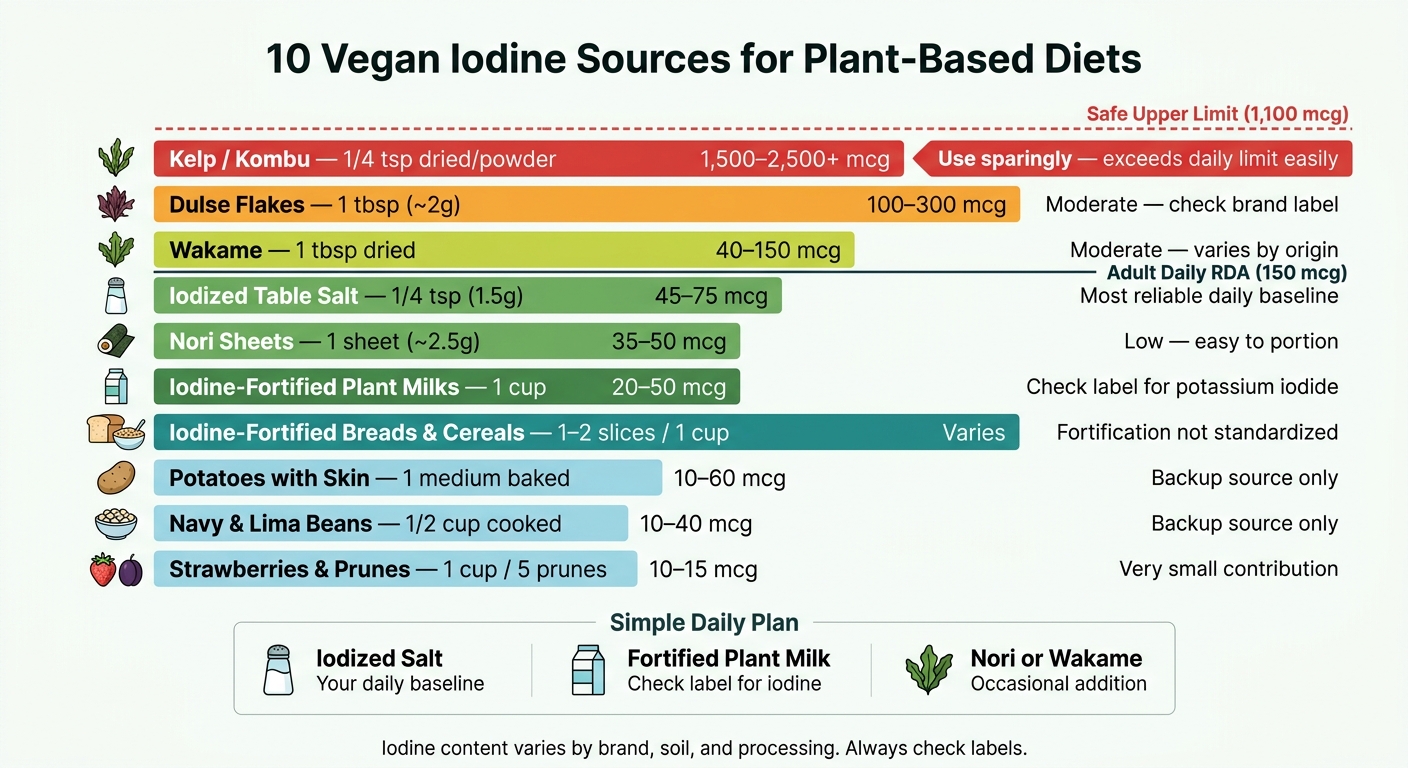
10 Vegan Iodine Sources: Levels, Servings & Safety at a Glance
Use this table for a fast scan when you want a steady iodine source without going too far. Focus on the iodine range column. A bigger range means that serving can shift a lot based on species, soil, processing, or brand.
| Source | Typical Serving | Iodine (mcg) | Key Caution |
|---|---|---|---|
| 1. Kelp / Kombu | 1/4 tsp (dried/powder) | 1,500 – 2,500+ | Most concentrated vegan iodine source; extremely easy to exceed the safe upper limit |
| 2. Nori Sheets | 1 sheet (~2.5g) | 35 – 50 | Lowest iodine among seaweeds - don't rely on it as your primary source |
| 3. Dulse Flakes | 1 tbsp (~2g) | 100 – 300 | Iodine varies by species and water source; strong ocean flavor |
| 4. Wakame | 1 tbsp (dried) | 40 – 150 | Moderate iodine; easy to portion - content varies by species and origin |
| 5. Iodized Table Salt | 1/4 tsp (1.5g) | 45 – 75 | High sodium; iodine levels can vary by brand |
| 6. Iodine-Fortified Plant Milks | 1 cup (8 fl oz) | 20 – 50 | Many brands are not fortified - always check the label |
| 7. Iodine-Fortified Breads and Cereals | 1–2 slices / 1 cup | Varies by brand | Fortification is not standardized; some products have no meaningful iodine |
| 8. Potatoes with Skin | 1 medium (baked) | 10 – 60 | Modest, variable iodine; backup source only |
| 9. Navy Beans and Lima Beans | 1/2 cup (cooked) | 10 – 40 | Small, variable iodine; backup source only |
| 10. Strawberries and Prunes | 1 cup / 5 prunes | 10 – 15 | Very small iodine contribution; high sugar in prunes , which is a key factor in stabilizing blood sugar |
Seaweeds show the biggest swings, and kelp is the toughest one to portion safely. Fortified foods are a different story: their iodine content depends on the brand and the fortification level. Use these ranges to keep your daily intake steady.
These sources work best when you pair them with other nutrients your thyroid needs. Selenium helps the thyroid convert hormones, and too little iodine or selenium can impair thyroid function. If you eat dulse or wakame on a regular basis, pair those meals with selenium-rich foods so your iodine intake does more for you.
Seaweed may also support gut health, which can help with blood sugar control. So it makes more sense as part of a full meal, not just a little extra on top. A simple way to do that is to build meals with tofu or lentils, quinoa, avocado, and a measured iodine source like wakame or iodized salt to support fullness, steadier blood sugar, and reliable iodine intake.
Aim for a steady daily intake from reliable sources like iodized salt or iodine-fortified plant milks. Pair that with enough protein, fiber, and healthy fat to help keep hormones and blood sugar on an even keel. The next section shows how to use these foods safely in daily meals.
These foods work best when they’re part of a steady day-to-day routine. A vegan diet can meet iodine needs, but it takes some planning. The adult RDA is 150 µg/day, and iodized salt is still the most reliable food-based choice. Seaweed gives you more options, but only if you keep portions in check.
Iodine levels can swing a lot depending on the type of seaweed. Nori is low, while kombu can go past 2,000 µg per gram. That’s a huge gap, which is why portion control and label checks matter so much.
Think steady, not all at once. Use iodized salt as your baseline, add fortified plant milks when the label shows iodine, and treat high-iodine seaweeds like kombu as occasional flavorings. Consistency beats spikes.
It depends on how much iodine you usually get from foods like iodized salt or seaweed. Since iodine in plant-based foods can swing quite a bit, experts often suggest iodized salt or a supplement to help you hit the adult daily target of 150 µg.
If you rarely use iodized salt and don't eat seaweed on a regular basis, a supplement may be the more dependable way to meet your needs.
For adults, the tolerable upper intake level for iodine is 1,100 micrograms per day.
That matters because the iodine in seaweed can swing a lot from one type to another. And if you get too much, it can affect thyroid function.
Brown seaweeds like kombu and kelp can go past safe limits in VERY small amounts. Nori is usually lower in iodine, which makes it the less risky pick.
The simple move: stick to small, occasional portions instead of eating seaweed every day.
You can still meet your iodine needs without iodized salt, but you may need to plan for it a bit more. Seaweed can help, but the amount of iodine can swing a lot. Kelp is often very high in iodine, while nori tends to be lower.
Another option is an iodine supplement or fortified foods, such as some plant-based milks. Check the label so you know how much you're getting. It also helps to talk with your healthcare provider, especially during pregnancy or lactation, so you can reach 150 mcg/day without going over safe limits.

