

The Top 5 PCOS Myths
Dr. Ami Patel, a pharmacist with PCOS herself, debunks the top 5 myths about polycystic ovary syndrome. From medications to diet advice, here's what the science actually says.

Perimenopause can make blood sugar less steady, even if your habits stay the same. From what I see in the research, soy foods and ground flaxseed may help a little with fasting glucose, insulin, and insulin sensitivity - but the effect is usually small, and it tends to show up more in women with insulin resistance or metabolic syndrome.
Here’s the short version:
If I had to sum it up in one line: <u>phytoestrogens are not a fix, but they can be one small part of a blood-sugar-friendly plan during perimenopause.</u>
| Food | Main compounds | Common intake studied | Who may see more effect | What it may help |
|---|---|---|---|---|
| Soy foods | Isoflavones | 50 mg/day | Women with insulin resistance | Fasting glucose, insulin, insulin sensitivity |
| Ground flaxseed | Lignans | 40 g/day | Women with higher metabolic risk | Cardiometabolic markers, visceral fat, insulin response |
So if you want the plain answer: start with food first - like tofu, tempeh, edamame, and ground flaxseed - then pair that with 25–35 g fiber per day and about 25–30 g protein per meal for steadier blood sugar.
Estrogen helps keep blood sugar on a more even keel. That’s why research on estrogen gives us a useful way to understand what may be happening to glucose control during perimenopause.
Most of the research on metabolism has focused on postmenopausal women, when estrogen levels are low and more stable. Perimenopause is tougher to study because estrogen doesn’t just drop and stay there - it swings up and down.
That matters. Perimenopause is a 2- to 4-year transition tied to hormone shifts, changes in body composition, and a higher risk of insulin resistance. So while postmenopausal studies don’t map perfectly onto perimenopause, they still help explain estrogen’s part in glucose control.
Menopausal hormone therapy (MHT) gives researchers a useful clue. When hormone levels are brought back up, studies often show better insulin sensitivity and better glycemic markers, including HbA1c and HOMA-IR.
A 2023 meta-analysis of 19 studies found that MHT had a neutral or modestly positive effect on blood sugar regulation in women with type 2 diabetes. At the same time, results can shift based on dose, route, and timing. Oral estrogen goes through the liver first, while transdermal delivery skips that step.
That variation helps explain why hormone-balancing foods like phytoestrogens have drawn attention. If estrogen seems to play a part in glucose metabolism, it makes sense to look at plant compounds that act in similar ways. That’s the reason soy and flax phytoestrogens are being studied for blood sugar support.
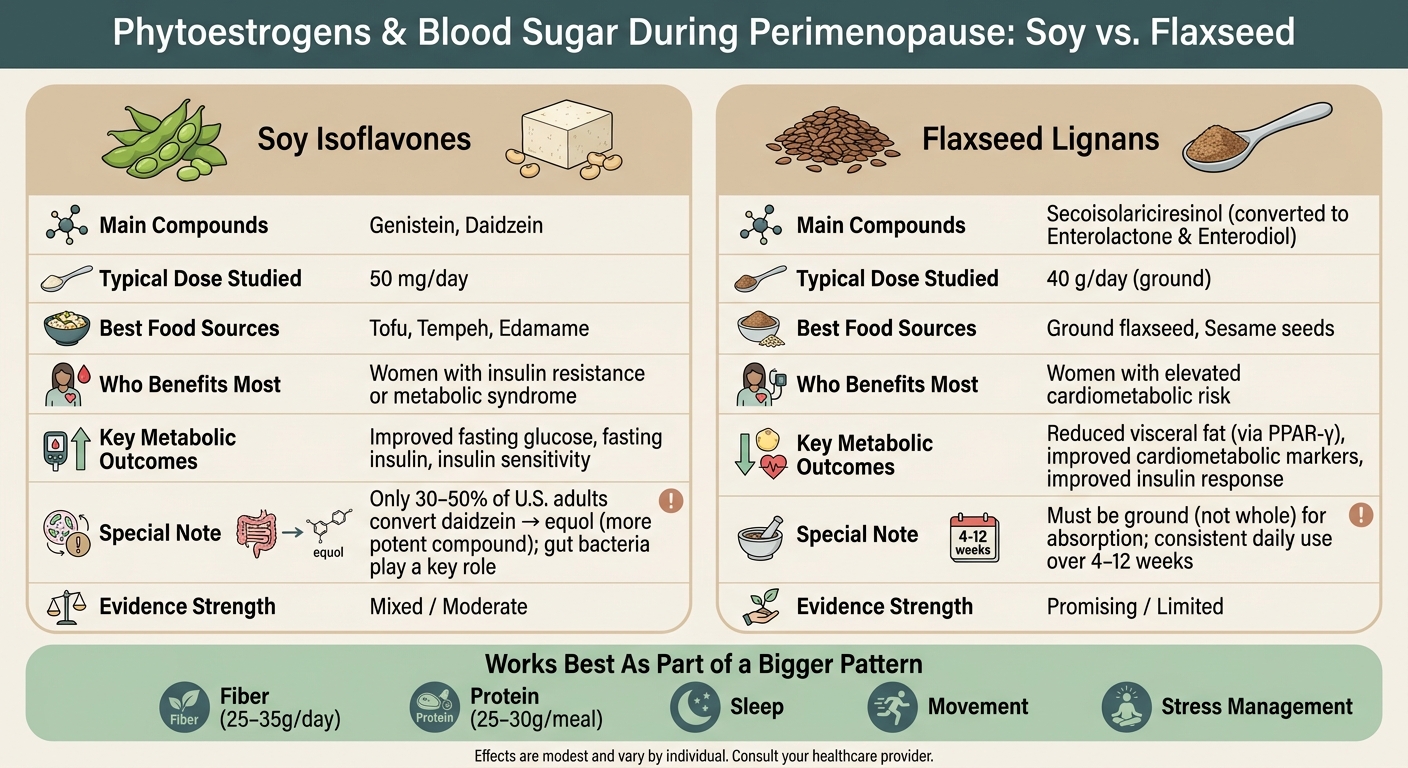
Phytoestrogens & Blood Sugar During Perimenopause: Soy vs. Flaxseed
Phytoestrogens are plant compounds that occur naturally in foods. This group includes isoflavones, lignans, coumestans, and stilbenes. They bind to estrogen receptors more weakly than the body’s own estrogen, with a stronger pull toward ERβ. During perimenopause, that mild estrogen-like effect may slightly shape glucose control. That’s why soy and flax deserve a closer look if blood sugar support is the goal during this stage of life.
The soy isoflavones genistein and daidzein are among the most studied phytoestrogens for metabolic health. Genistein may help insulin do its job a bit better.
Some studies link 50 mg/day of soy isoflavones with better glucose control, but the findings are mixed. Dose matters. The source matters too, since soy from foods and soy from supplements may not act the same way. A person’s starting metabolic health also seems to shape the response. Women with insulin resistance may see more effect than women without it. On top of that, gut bacteria differ in how they convert daidzein into equol.
The clearest signal shows up in women with insulin resistance.
Flaxseeds are one of the richest food sources of lignans. Gut bacteria turn these lignans into enterolactone and enterodiol, which can interact with estrogen receptors. Flaxseed may also support insulin sensitivity through PPAR-γ.
The flax research looks promising, but there’s less of it than there is for soy. Studies suggest flaxseed may help cardiometabolic markers, especially in women with higher metabolic risk. In healthier groups, the results are less steady. In practice, a food-as-medicine approach often uses 40 g/day of ground flaxseed as a workable target for lignans and fiber.
These effects matter most when flax is ground and eaten on a steady basis.
The strongest signal appears in women with insulin resistance or metabolic syndrome. In that group, foods rich in phytoestrogens may have more effect on fasting glucose, fasting insulin, and HOMA-IR than they do in women without metabolic concerns.
| Intervention | Primary Compound | Typical Dose | Population with Strongest Signal | Main Glycemic/Metabolic Outcomes |
|---|---|---|---|---|
| Soy isoflavones | Genistein, daidzein | 50 mg/day | Women with insulin resistance | Improved glucose control; modest benefits in fasting glucose and insulin |
| Flaxseed lignans | Secoisolariciresinol | 40 g/day, ground | Women with elevated cardiometabolic risk | Reduced visceral fat via PPAR-γ modulation; improved cardiometabolic profile |
Whole-food sources like tofu, tempeh, edamame, and ground flaxseed are usually the better starting point because they also bring fiber and other useful compounds. Fermented soy may improve isoflavone availability. From there, the focus shifts to fitting these foods into a protein- and fiber-rich eating pattern that helps keep blood sugar on a more even keel.
The gains here are modest, so this works best as one piece of a bigger eating pattern. The research points to phytoestrogen-rich foods fitting well into a plan built around more fiber, enough protein, and less added sugar.
Start with whole foods when you can. Ground flaxseed is an easy add-in for oatmeal or smoothies. Just use ground flaxseed, not whole seeds. Tempeh, edamame, and firm tofu are also good picks. If you’d rather skip soy, ground flaxseed and sesame seeds are simple lignan-rich choices.
The main idea is consistency, not chasing an exact dose. Most studies look at regular intake over 4 to 12 weeks.
This works even better when each meal includes fiber and protein too.
Fiber does more than help with fullness. It also feeds the gut bacteria involved in turning daidzein into equol, a stronger compound. A good target is 25–35 grams of fiber per day from vegetables, legumes, and seeds to support gut health and steadier post-meal glucose.
Protein matters just as much. During perimenopause, muscles don’t respond to protein as well, and muscle is the main place where glucose gets cleared from the blood. A solid target is 25–30 grams of protein at each meal to help support muscle and steadier blood sugar. That can matter even more during perimenopause, when glucose swings and appetite changes often feel harder to handle.
There’s also a simple meal-building rule that helps: pair carbohydrates with protein or fiber each time you eat. That slows glucose absorption and helps blunt the post-meal spikes that often get more noticeable during perimenopause.
Whole foods should do most of the heavy lifting. But life happens, and not every meal is going to be a sit-down plate with vegetables, protein, and seeds on top. In those moments, the snack you grab can make a difference.
Resist Nutrition bars fit this pattern with 12 g of plant protein and 14 g of fiber, with no added sugar, soy, or gluten.
These food-based steps line up with the evidence, but the research still has some limits.
The mixed results matter. Right now, the research points to modest effects, not dramatic ones.
The data is promising, but it isn't consistent. Many trials are small, short, and use different doses, which makes side-by-side comparison tough. On top of that, perimenopause is often lumped together with postmenopause, even though it is a separate metabolic shift with its own patterns.
The gut microbiome makes this even more complicated. Only 30% to 50% of people in the U.S. can convert daidzein into equol, which is a more potent estrogenic compound. That helps explain why average study results can seem small, even when some women do quite well. In plain English: one person may respond, another may not, and the average lands somewhere in the middle.
It also helps to separate study types. RCTs are better for testing cause and effect, but they are often small and short. Observational studies can show patterns over time, but they can't prove causation.
Taken together, the research backs a food-first, individualized approach. Soy and ground flaxseed may help with blood sugar, but the effect is usually modest and can vary a lot from person to person. A big part of that response seems to come down to gut metabolism, especially whether the body turns daidzein into equol.
Perimenopause also changes glucose handling in ways phytoestrogens only partly address. That's why these foods tend to work best as part of the bigger picture, not as a fix on their own. Think:
Those basics still do a lot of the heavy lifting.
Working with a healthcare provider to check fasting glucose, A1c, and insulin every six months during active perimenopause may help spot metabolic shifts early.
Yes. During perimenopause, shifts in estrogen can make insulin resistance more likely. Research suggests that phytoestrogens, including soy isoflavones, may help support blood sugar control by acting on estrogen receptors and insulin-related pathways.
Foods rich in phytoestrogens, like flax meal, soybeans, and legumes, may help support that process. Resist Nutrition’s doctor-formulated bars are made to support steady blood sugar and hormone health with functional ingredients.
It depends on which health marker you're tracking.
With ground flaxseed, studies have seen metabolic shifts - like lower glucose, insulin, and HbA1c - within 8 to 12 weeks.
Hormone-related effects can take more time. Some studies found changes in estrogen metabolites after 7 weeks. That said, short-term symptom relief wasn't always statistically significant.
Women in perimenopause are the group most likely to benefit. That’s especially true for those dealing with mild to moderate symptoms such as hot flashes, vaginal dryness, or concerns around bone density, cognitive function, insulin resistance, or blood sugar stability.
They may also help people managing PCOS, postmenopausal women, and others who want support with overall hormonal balance.

