

How Pea Protein Supports PCOS Management
If you have PCOS, pea protein may help by making blood sugar spikes, hunger, and meal timing easier to control. Since up to 80% of women with PCOS deal with insulin resistance, steadier meals can...

If you go more than 4 to 5 hours without eating, a snack may help keep your blood sugar more steady. The best time usually falls into five windows: mid-morning, mid-afternoon, before a workout, after a workout, or before bed if overnight lows are a concern.
Here’s the short version:
What matters most is not just when you snack, but what you eat. A blood sugar-friendly snack usually includes:
For example, fruit with peanut butter or Greek yogurt with berries will usually work better than chips, sweets, or a carb-only snack.
| Snack window | Best time to use it | Main goal | Skip it if |
|---|---|---|---|
| Mid-morning | Breakfast and lunch are more than 4–5 hours apart | Help prevent a late-morning dip | Lunch is soon |
| Mid-afternoon | Lunch was early and dinner is still hours away | Help with energy and avoid overeating at dinner | Dinner is 1–2 hours away |
| Pre-workout | 30–60 minutes before exercise | Help prevent exercise-related lows | You just ate or blood sugar is already high |
| Post-workout | 45–90 minutes after long or hard exercise | Refuel and recover | Activity was short and light |
| Bedtime | Close to bed, only when overnight lows are a risk | Help prevent nighttime lows | You don’t have a history of overnight lows |
The bottom line: use a snack to cover your biggest gap in the day, not as an extra meal. If I were keeping it simple, I’d start with the longest stretch between meals, then pick a small snack with 10 to 20 grams of protein, at least 3 grams of fiber, and a modest amount of carbs when it fits.
Going more than 4 to 5 hours without eating can lead to blood sugar dips, especially for people who take certain medications. Lindsey DeSoto, RD, puts it this way:
"Going too long without eating can leave you overly hungry by lunchtime. It may cause low blood sugar in some people." - Lindsey DeSoto, RD
That gap matters. The longer you wait, the more hunger can build, and blood sugar may swing more than usual. When that happens, the next meal often ends up larger and heavier in glucose, which can set off a sharper spike. A small snack between meals can help stop blood sugar from dropping too far and may also soften that next-meal spike.
Exercise can change the picture too. If you work out between meals, having a small snack 15 to 30 minutes before activity may help prevent a blood sugar dip.
What kind of snack works best? One that slows digestion instead of hitting all at once. As Jamie Mullally, M.D., explains:
"Fiber slows digestion and glucose absorption, while protein and fat help blunt rapid rises in blood sugar and help with satiety." - Jamie Mullally, M.D., Endocrinologist, New York Medical College
A good rule of thumb is to choose snacks with:
In plain English, timing helps most when the snack itself is built to keep blood sugar on a more even track. A snack with protein, fiber, and healthy fat can help keep blood sugar steadier between meals.
A blood sugar friendly snack usually has protein, fiber, and healthy fat, plus a small serving of carbs. That mix helps the snack feel more balanced, not like a quick hit that disappears in an hour.
Snacks made of carbs alone tend to move blood sugar up faster. Paired snacks work better. For example, an apple with peanut butter raises blood sugar more slowly than an apple by itself because the fat and protein slow how fast the fruit’s natural sugars are absorbed.
Timing matters too. If your next meal is more than 4 to 5 hours away, aim for a snack with about 10 to 20 grams of protein. That can help you stay steady between meals instead of running on fumes.
Packaged snacks aren’t off-limits, but you do need to read the label. Many products sold as "low-fat" make up for lost fat with added sugar, which can increase glycemic impact. When whole foods aren’t an option, a lower-sugar protein bar can still be a good pick.
Mid-morning is often the first snack window that makes sense. It works best when breakfast happens early and lunch is still a while away. Registered dietitian Lindsey DeSoto puts it this way:
"A mid-morning snack may be helpful if it keeps you on a more regular eating schedule, especially when breakfast is early and lunch is still several hours away."
Using the 4- to 5-hour rule, a good target is 10:00 AM to 11:30 AM. This timing can matter even more for people who take insulin or certain diabetes medications, since they may be more likely to deal with blood sugar dips.
Aim for 15 to 20 grams of carbs and pair those carbs with protein, fiber, or fat. That combo tends to help keep things steadier between meals. For example, almonds and celery will usually have less effect on blood sugar than a granola bar.
Good picks include:
If breakfast holds you over until lunch, you can skip this window. If it doesn’t, this is a smart time to fill the gap.
If a morning snack doesn’t do much for you, the afternoon is often where things start to drift. This window tends to work best when lunch happens early and dinner is still a few hours out. As Lindsey DeSoto, RD, notes:
"A balanced snack can cover the gap and help keep dinner portions steadier."
If you tend to get irritable, distracted, or low-energy around 3:00 PM or 4:00 PM, this is probably the snack window to pay attention to.
The main idea is simple: head off the post-lunch slump and reduce the odds of a bigger blood sugar jump at dinner. A 2023 study found that people who ate afternoon snacks with soluble fiber had a lower rise after dinner.
Try having your snack 2 to 3 hours after lunch and at least 2 hours before dinner. For most people, that means somewhere in the 2 to 4 p.m. range. As Johannah Katz, RD, said:
"Most people land in the 2 to 4 p.m. window."
Use the same balanced setup here: 10 to 20 grams of protein, at least 3 grams of fiber, and 10 to 20 grams of carbs.
A few solid picks:
This window works well when your workout lands between meals. If it’s been 4 to 5 hours since your last meal - like an after-work gym session later in the day - a small snack can help you avoid that pre-exercise slump. It can be especially helpful for people who take insulin or tend to deal with low blood sugar.
The goal is straightforward: help stop a blood sugar drop during exercise. For people with diabetes, the usual pre-exercise target is 100–180 mg/dL.
Try to have your snack 30 to 60 minutes before moderate activity. That timing gives your body a little room to digest while still putting fuel in the tank.
Go with a small snack that combines carbs with protein or a healthy fat. As Lindsey DeSoto, RD, advises:
"If you need a snack before exercise, choose something small with carbohydrates and protein, such as fruit with peanut butter or whole-grain crackers with cheese."
That can look like:
After exercise, the job changes. Now it's about refueling and recovery.
This snack window makes the most sense after hard workouts or sessions that last more than an hour. If your workout was short or easy, and you're eating a balanced meal within the next few hours, you can likely skip the snack.
Exercise uses up glucose stores. On top of that, insulin sensitivity tends to go up after a workout, which can lead to a blood sugar drop, especially if you use insulin.
The goal here is simple: refill glycogen, support recovery, and help prevent delayed low blood sugar.
Try to eat within 45 to 90 minutes after training. That timing can help with recovery and keep blood sugar on a steadier path.
As Lindsey DeSoto, RD, puts it:
"After intense exercise or activity that lasts more than an hour, a snack with carbohydrates and protein can help you refuel and recover."
Post-workout snacks can lean a little higher in carbs than snacks in other windows, since you're replacing what you just burned through. Add protein too. That combo helps muscle recovery and can smooth out the glucose response.
A few solid options:
If you take insulin or tend to get low blood sugar, keep fast-acting carbs nearby, like glucose tablets or juice, for immediate use during or after exercise.
For some people, the last snack window that makes sense is right before bed. But this isn't something everyone with diabetes needs.
A bedtime snack is most useful when overnight lows are a risk, especially if you take insulin or sulfonylureas.
If your blood sugar tends to stay steady through the night without food, there's usually no reason to add a snack. Studies haven't shown that bedtime snacks help blood sugar across the board for everyone with diabetes.
The goal here is pretty simple: help prevent overnight lows without causing a late-night spike.
That means the snack needs to stay small and be eaten close to bedtime. Think of it as a light buffer before sleep, not a second dinner.
If you do need a bedtime snack, eat it after dinner and close to bedtime. In other words, leave some space after dinner, then have a small snack only if there's a clear reason for it.
That timing matters. Late-night eating can be tougher on blood sugar because insulin sensitivity is naturally lower in the evening.
Keep the snack small and built to slow digestion. A smart bedtime option pairs a fiber-containing carb with protein or a healthy fat to help limit a glucose rise overnight.
A good target looks like this:
Skip chips, sweets, and refined-flour snacks. Those foods can push blood sugar up fast at night, which is the opposite of what you want.
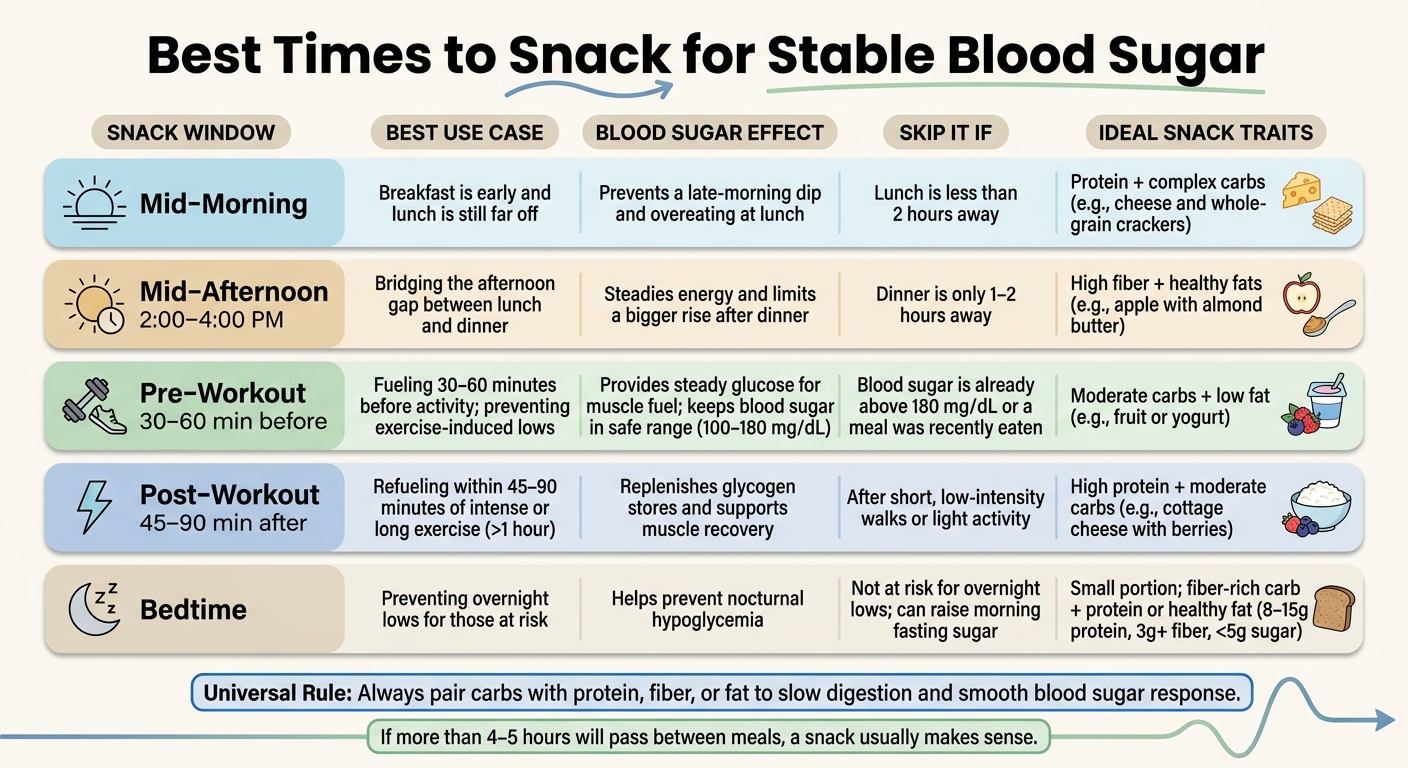
Best Times to Snack for Stable Blood Sugar: 5 Windows Explained
Not every snack does the same job. The best timing depends on how far away your next meal is, whether you're about to work out, and how your blood sugar tends to act during the day, especially if you notice signs your blood sugar is out of balance. Use the table below to line up each snack window with what’s happening in your schedule. Start with the one that fits your next meal, activity, or overnight low risk.
| Snack Window | Best Use Case | Blood Sugar Effect | Skip It If | Ideal Snack Traits |
|---|---|---|---|---|
| Mid-Morning | Breakfast is early and lunch is still far off | Prevents a late-morning dip and overeating at lunch | Breakfast and lunch are closely spaced, or lunch is less than 2 hours away | Protein + complex carbs (e.g., diabetic friendly protein bars or cheese and whole-grain crackers) |
| Mid-Afternoon | Bridging the afternoon gap | Steadies energy and limits a bigger rise after dinner | Dinner is only 1–2 hours away | High fiber + healthy fats (e.g., apple with almond butter) |
| Pre-Workout | Fueling 30–60 minutes before activity; preventing exercise-induced lows | Provides steady glucose for muscle fuel; keeps blood sugar in a safe range | Blood sugar is already high (>180 mg/dL) or a meal was recently eaten | Moderate carbs + low fat for quick absorption (e.g., fruit or yogurt) |
| Post-Workout | Refueling within 45–90 minutes of intense or long-duration exercise (>1 hour) | Replenishes glycogen stores and supports muscle recovery | After short, low-intensity walks or light activity | High protein + moderate carbs (e.g., cottage cheese with berries) |
| Bedtime | Preventing nocturnal hypoglycemia for those at risk | Helps prevent overnight lows | Not at risk for overnight lows; can leave morning fasting sugar higher | Small portion; fiber-rich carb + protein or healthy fat |
One simple rule runs through every window: pair carbs with protein, fiber, or fat. That combo tends to slow digestion and smooth out blood sugar. Later in the day, smaller portions often make more sense, especially when you choose foods that digest more slowly. Use the chart to narrow down what fits your day best.
Start by looking at the longest stretch between meals or workouts. Monitoring your glucose levels can help you identify these gaps. Then place your snack there. A simple rule: if more than 4–5 hours will pass between meals, a snack usually makes sense. If your meals are closer than that, you can often skip it.
Here’s how that plays out in daily life:
For most people, mid-afternoon is the most useful snack window. Bedtime snacks are better saved for times when overnight lows are a real risk.
The goal is simple: use a snack to cover your biggest gap, not to turn it into a second meal.
Each snack window fits a different part of the day, whether you're filling a long gap between meals, eating around a workout, or having something before bed. Snack timing isn't about eating more. It's about eating at the right time. A planned snack can help you avoid going too long without food and may help keep blood sugar on a more even track.
For the snack itself, keep it simple: build it around protein and fiber, then add healthy fats and a small amount of carbs. That combo slows digestion and can help reduce sharp glucose swings. Put another way, match the snack window to your schedule, then keep the snack balanced and portion-controlled. That's the simplest way to support steadier blood sugar between meals. For a convenient option, Resist Bars are designed with this exact nutrient balance in mind.
You may not need a snack if regular, balanced meals keep you full and your blood sugar stays steady. A snack is a tool to use when it helps, not something you have to eat every day.
A snack can make sense if you go more than four to five hours between meals, need fuel for exercise, or notice a dip in energy or blood sugar. If you're hungry or dealing with cravings, Resist Nutrition protein bars can be a convenient, balanced option.
If you snack before a workout, eat 30 to 60 minutes before you start. Go with something small that has protein and carbohydrates. That combo can give you energy and help keep your blood sugar steady.
A simple pick is a small banana with 1 tablespoon of peanut butter. Resist Nutrition protein bars are another easy grab-and-go option.
For most people, eating right before bed isn’t a great move. Late-night snacking can interfere with insulin function and push blood sugar up.
That said, a bedtime snack can help in some cases. It may be worth it if you’re at risk for nocturnal hypoglycemia or if you often wake up hungry in the middle of the night.
If you do need something before bed, keep it small and go for a nutrient-dense, low-glycemic option. Resist Nutrition protein bars are a good fit here.

