We're reformulating our bars with an even better recipe. Sign up for early access and get an exclusive re-launch discount.
Study: Snack Timing and Blood Sugar Fluctuations
By Resist Team
When you snack matters as much as what you snack on. Research shows that late-night snacking negatively impacts blood sugar regulation due to hormonal changes like increased melatonin, which suppresses insulin secretion. This can lead to prolonged elevated blood sugar levels, particularly in individuals with Type 2 diabetes, PCOS, or insulin resistance.
Key takeaways:
Late-night snacking: Increases glucose levels and suppresses insulin release.
Morning vs. evening snacking: Early eaters process sugar better; late eaters face challenges due to circadian misalignment.
Chronotypes matter: Early risers struggle with evening glucose control, while night owls face issues with early morning meals.
Snack quality counts: Protein and fiber-rich snacks stabilize blood sugar better than high-carb, sugary options.
To improve blood sugar control:
Snack earlier in the day, ideally before 5:00 PM.
Choose balanced snacks with protein, fiber, and healthy fats.
Avoid eating close to bedtime, especially after 9:00 PM.
Timing your snacks wisely can help you manage your blood sugar and support overall metabolic health.
Study Design and Research Overview
Core Research Question
The research centers on a simple yet important question: does the timing of your snacks influence how your body processes blood sugar? To answer this, two studies were conducted. One examined everyday snacking patterns across a large population, while the other used a controlled lab setting to test specific snack timings. Both studies also delved into the concept of circadian misalignment - which occurs when eating patterns conflict with your body’s natural internal clock. Let’s take a closer look at how these studies were designed.
Study Population and Methods
The research drew its insights from two key studies:
ZOE PREDICT 1 study: Conducted between June 2018 and May 2019 (NCT03479866), this study tracked 854 adults in the UK. Participants had an average age of 46.1 years and a mean BMI of 25.6 kg/m². The group was predominantly female (73%). Using a mobile app, participants recorded detailed food diaries, while researchers monitored metabolic markers like HbA1c, insulin, and triglycerides through continuous glucose monitoring (CGM) and blood tests.
ChroNu study: Carried out at Paderborn University, this study focused on a younger group, screening 327 students aged 18–25 between September and December 2020. Out of these, 45 participants with distinct early or late chronotypes were selected. In a randomized cross-over design, participants consumed the same high-glycemic index meal (Mars bar, cornflakes, milk, and a pretzel) at two fixed times: 7:00 a.m. and 8:00 p.m. Glycemic responses were tracked using CGM over 2-hour and 24-hour periods.
"From a screening of 327 students aged 18–25 years, those with early (n = 22) or late (n = 23) chronotype participated in a 7-day randomized controlled cross-over intervention study." - European Journal of Nutrition
Defined Snack Periods
Each study defined its snack timing windows differently, offering a comprehensive view of snacking across the day. In the ZOE PREDICT 1 study, participants were grouped into four time-based categories based on when they consumed over 50% of their total snack calories. Those without a clear pattern were classified as "grazers."
Study
Timing Window
Definition
ZOE PREDICT 1
Morning
Before 12:00 p.m.
ZOE PREDICT 1
Afternoon
12:00 p.m. – 6:00 p.m.
ZOE PREDICT 1
Evening
After 6:00 p.m.
ZOE PREDICT 1
Late-Evening
At or after 9:00 p.m.
ChroNu Study
Morning intervention
Fixed at 7:00 a.m.
ChroNu Study
Evening intervention
Fixed at 8:00 p.m.
Interestingly, 31% of ZOE participants fell into the late-evening snacker category, a time later highlighted as potentially problematic for metabolic health. These defined windows set the stage for analyzing how snack timing affects blood sugar regulation and overall metabolic outcomes.
sbb-itb-40fb9b7
Let’s talk diabetes | How late night eating affects blood sugar
Key Findings on Blood Sugar Fluctuations
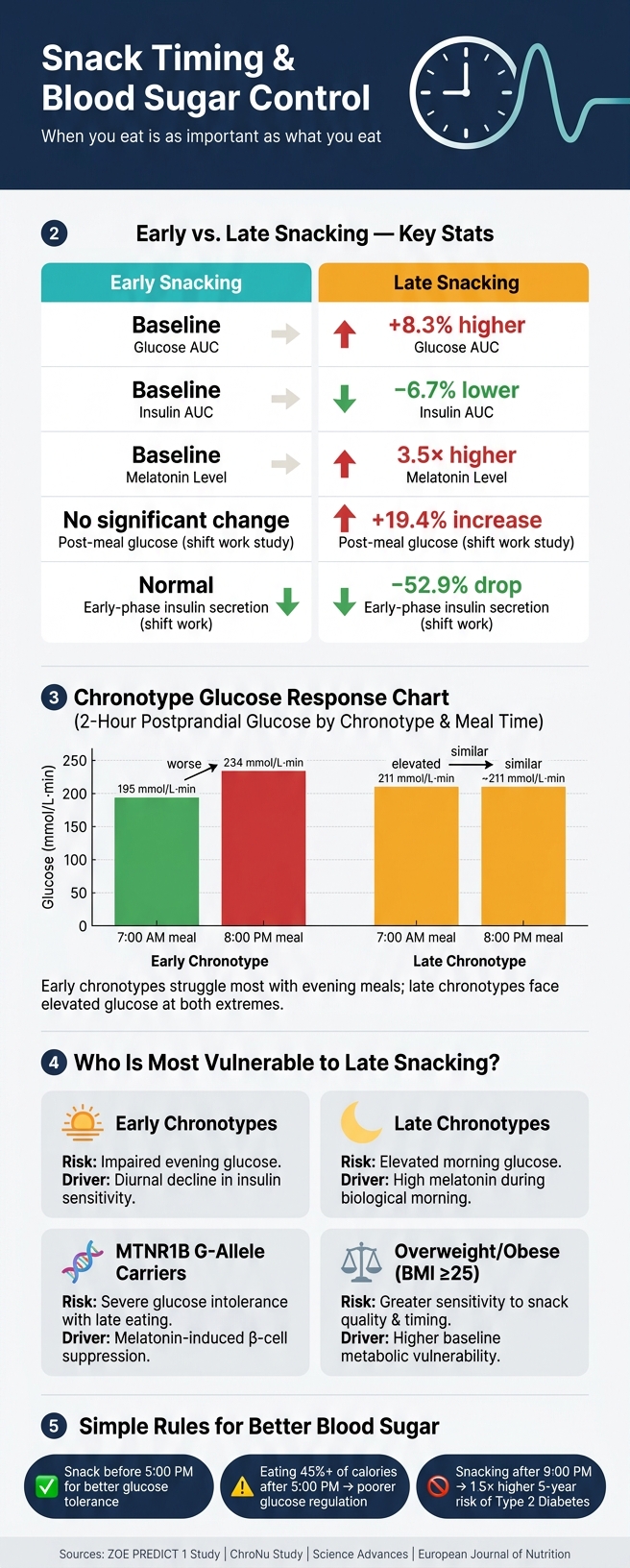
Snack Timing & Blood Sugar: Early vs. Late Eating by Chronotype
Early vs. Late Snacking: What the Data Shows
Data from both studies highlights one thing: eating late in the day makes it harder for your body to regulate blood sugar. For example, eating just an hour before bedtime increased glucose AUC by 8.3% compared to eating four hours earlier. At the same time, insulin AUC dropped by 6.7%, showing a decrease in insulin release during these critical periods.
The hormone melatonin plays a big role here. Melatonin - your natural sleep hormone - peaks at night and actively suppresses insulin secretion. During late-night eating, melatonin levels were 3.5 times higher than during early-evening eating, making it harder for the body to clear glucose from the bloodstream. These effects also vary depending on your chronotype, or your natural sleep-wake cycle.
Blood Sugar Patterns Across Timing Windows
Chronotypes have a big impact on glycemic response. According to the ChroNu study, people with an early chronotype had worse glucose responses in the evening. Their 2-hour postprandial glucose reached 234 mmol/L·min at 8:00 p.m., compared to 195 mmol/L·min at 7:00 a.m.. On the other hand, late chronotypes didn’t show a significant difference between morning and evening responses. However, their morning glucose response was still elevated at 211 mmol/L·min, likely because a 7:00 a.m. meal falls during their biological night when melatonin levels remain high. These findings reinforce the connection between circadian rhythms and how snack timing affects blood sugar.
"Diurnal differences in response to a high GI meal are confined to those young adults with early chronotype, whilst those with a late chronotype seem vulnerable to both very early and late high GI meals." - European Journal of Nutrition
What These Findings Mean for At-Risk Groups
These findings carry significant weight for certain at-risk groups. For instance, individuals carrying the MTNR1B G-allele show much worse glucose tolerance with late eating. Elevated melatonin levels further suppress β-cell function, reducing the pancreas's ability to secrete insulin.
"Concurrently high endogenous melatonin and carbohydrate intake, as typical for late eating, impairs glucose tolerance, especially in MTNR1B G-risk allele carriers, attributable to insulin secretion defects." - Marta Garaulet, Department of Physiology, University of Murcia
For people with overweight or obesity (BMI ≥ 25 kg/m²), snack quality becomes even more critical. In this group, high-quality snacks are more strongly linked to lower triglycerides and better insulin sensitivity than in lean individuals. This underscores the importance of aligning snack timing with individual biological rhythms to improve glycemic control.
Group
Primary Timing Risk
Biological Driver
Early Chronotypes
Impaired glucose control in the evening
Diurnal decline in insulin sensitivity
Late Chronotypes
Similar glycemic responses in the morning and evening, with elevated morning levels
Persistent high melatonin during the biological morning
MTNR1B G-Allele Carriers
Severe glucose intolerance with late eating
Melatonin-induced β-cell suppression
Overweight/Obese Individuals
Greater sensitivity to snack quality and timing
Higher baseline metabolic vulnerability
Why Snack Timing Affects Blood Sugar
Our body's biological rhythms play a big role in how we process food. Metabolism doesn't operate the same way throughout the day - it functions differently in the morning compared to late at night. This is largely influenced by our internal clocks.
Circadian Rhythm and Insulin Sensitivity
Our internal timing systems, known as circadian rhythms, are fascinatingly complex. The brain's central clock is regulated by light, while peripheral metabolic clocks - like those in the liver and pancreas - are influenced by food intake. Ideally, these clocks work in harmony. But when we eat late at night, it can throw them out of sync with light-based cues, leading to poorer glucose control. In fact, research has found a strong correlation (r = 0.86) between these misalignments and impaired glucose tolerance.
"Food timing synchronizes peripheral metabolic circadian rhythms, but not central circadian rhythms, possibly resulting in an uncoupling between peripheral and central circadian rhythms." - Science Advances
This misalignment disrupts the body's natural rhythm, setting the stage for altered insulin responses. This connection becomes even clearer when examining the effects of nighttime eating on glucose intolerance.
Nighttime Eating and Glucose Intolerance
Late-night snacking adds another layer of disruption to glucose regulation. Melatonin, a hormone that rises as the body prepares for sleep, plays a key role here. Elevated melatonin levels suppress insulin secretion from pancreatic beta-cells. Without enough insulin, glucose remains in the bloodstream longer, impairing the body's ability to manage blood sugar effectively.
This phenomenon has been demonstrated in controlled studies. In one 14-day study published in Science Advances, researchers Frank A.J.L. Scheer and Richa Saxena examined 19 healthy participants. Those who consumed meals spanning both day and night - mimicking shift work - saw a 19.4% increase in post-meal glucose levels and a 52.9% drop in early-phase insulin secretion. On the other hand, participants who ate the same number of calories exclusively during daytime hours showed no significant issues with glucose tolerance.
The early-phase insulin response is critical for quickly managing blood sugar spikes after eating. A significant reduction in this response during nighttime eating means blood sugar stays elevated longer, which can strain metabolic health over time.
Practical Tips for Managing Blood Sugar Through Snack Timing
Understanding the science is one thing - putting it into practice is another. Small changes in when and what you snack on can have a noticeable impact on keeping your blood sugar levels steady throughout the day.
When to Snack for Stable Blood Sugar
Daytime snacking has been shown to support better glucose tolerance. Research highlights that eating 45% or more of your daily calories after 5:00 PM can lead to poorer glucose regulation, even if your overall calorie intake and weight stay the same. Plus, eating after 9:00 PM increases the five-year risk of developing type 2 diabetes by 1.5 times.
Having a balanced snack about two hours before your largest meal can help reduce post-meal glucose spikes. One study published in the European Journal of Nutrition found that snacking at 5:00 PM - two hours ahead of a 7:00 PM dinner - helped lower post-dinner glucose levels across various snack types, including black beans, sweet potatoes, and fruit granola.
"Late eating is associated with poor glucose tolerance, independent of body weight, fat mass, energy intake, and diet composition in prediabetes or early onset type 2 diabetes." - Nutrition & Diabetes
The "check-test-check" method can help you fine-tune your snack timing. Measure your blood sugar before a snack and then again two hours afterward to see how your body responds.
Now that timing is covered, let’s look at how the type of snack you choose can enhance these benefits.
Snack Choices That Support Blood Sugar Stability
Timing is essential, but the nutritional makeup of your snack plays an equally important role. Opt for snacks rich in protein, fiber, and healthy fats to slow digestion and minimize glucose spikes. Research shows that snack quality matters more for metabolic health than how often you snack.
Here’s the catch: Snacks tend to be higher in carbohydrates (58% vs. 34% in meals) and sugar (39% vs. 17%), while being lower in protein (10% vs. 15%) - a combination that can cause rapid blood sugar swings. However, eating protein or fiber before carbohydrates can lower glucose spikes by as much as 1.9 mmol/L in normal-weight adults.
For example, Resist Nutrition protein bars are specifically designed to support stable blood sugar. These vegan bars pack 12g of protein and 14g of fiber, with only 4g of net carbs and no added sugar. Free from sugar alcohols, gluten, and soy, flavors like Peanut Butter Turmeric and Cinnamon Chocolate Chip are great options for daytime snacking.
Snack Timing for Different Lifestyles
Your lifestyle can influence the best snack timing strategy. A general rule? Aim to consume more of your snack calories earlier in the day.
For busy professionals, the mid-afternoon energy crash often leads to grabbing processed, sugary snacks. Prepping a balanced snack high in protein and fiber, and eating it before 5:00 PM, can help you avoid this pitfall.
For parents, treating snacks as mini-meals with a balance of protein and fiber is a better approach than relying on high-sugar convenience foods.
For fitness enthusiasts, timing a protein-rich snack around workouts can be beneficial. Just avoid heavy caloric intake late in the evening after exercising.
"Snack quality and timing of consumption are simple diet features which may be targeted to improve diet quality, with potential health benefits." - European Journal of Nutrition
Conclusion: What the Research Tells Us About Snack Timing
When it comes to snacking, timing matters just as much as what you eat. For many Americans, snacks make up a big chunk of their daily calories, but unfortunately, the quality of those snacks often lags behind that of regular meals. Research shows that when you snack can significantly influence your metabolism, making it essential to rethink not only what we snack on but also when.
Two key takeaways stand out. First, the quality of your snacks has a bigger impact on cardiometabolic health than how often you snack. Second, while people may focus on eating balanced meals, they often fall short with their snack choices - opting for lower-quality options that can quietly disrupt blood sugar levels over time. The good news? You don’t need to overhaul your entire diet to fix this. Simply choosing better snacks earlier in the day can make a noticeable difference.
Meal sequencing also plays a big role. Research shows that eating protein or fiber before carbohydrates can reduce glucose spikes by up to 45.8% and lower the overall glucose response by as much as 55% in normal-weight adults. This aligns with earlier findings that emphasize the importance of daytime snacking and syncing food intake with your body’s natural rhythms. As one study explains:
"Adjusting the order of food consumption can effectively mitigate acute postprandial glucose responses in healthy individuals." - Clinical Nutrition Research
If you're looking for a simple way to put these principles into practice, Resist Nutrition protein bars are a great option. Each bar provides 12g of protein and 14g of fiber, with just 4g of net carbs and no added sugar. They’re designed to help stabilize blood sugar while offering convenience and taste.
FAQs
How late is “too late” to snack for blood sugar?
Snacking close to bedtime can interfere with stable blood sugar levels. While a small, nutrient-rich, low-glycemic snack might help maintain balance overnight, eating immediately before sleep can make blood sugar regulation more challenging. It's best to leave a little time between your last snack and heading to bed to support better overall stability.
Does snack timing matter if I eat a healthy snack?
Yes, it does. Studies indicate that when you eat snacks can influence blood sugar levels, even if the snacks themselves are nutritious. Consistency in snack timing may help keep blood sugar more stable throughout the day, reducing fluctuations and promoting better overall energy balance.
How do I adjust snack timing if I’m a night owl or work shifts?
To keep blood sugar levels in check while working night shifts or staying active late, try syncing your eating schedule with your circadian rhythm. This means focusing on eating during what would be your biological daytime, even if it doesn’t match traditional meal times. Having a nutrient-packed, low-glycemic snack before heading to bed can help keep your blood sugar steady through the night. The key is consistency - timing meals to align with your active hours can make a big difference in managing blood sugar effectively.