We're reformulating our bars with an even better recipe. Sign up for early access and get an exclusive re-launch discount.
How to Read Nutrition Labels for Blood Sugar Control
By Drew Lederman
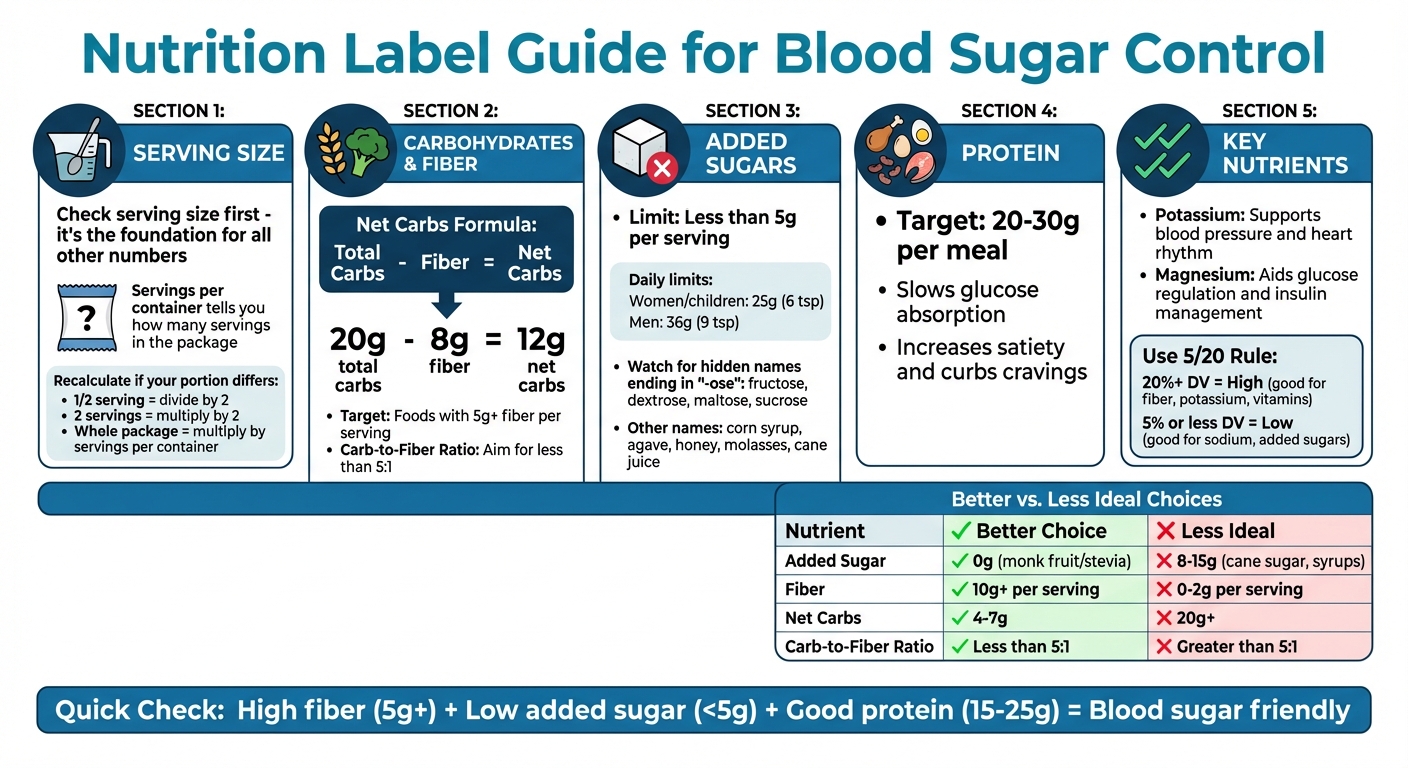
Reading nutrition labels can help you manage blood sugar effectively. Focus on these key areas:
Serving Size: Always check the serving size and servings per container. Adjust the label's numbers based on how much you eat.
Carbohydrates and Fiber: Look at total carbs, subtract fiber to calculate net carbs, and prioritize high-fiber foods (5g or more per serving).
Added Sugars: Limit added sugars to less than 5g per serving. Check for hidden sugars in the ingredients list.
Protein: Aim for 20-30g of protein per meal to slow glucose absorption and maintain energy.
Key Nutrients: Choose foods with potassium, magnesium, and a low carb-to-fiber ratio (under 5:1).
Start by comparing labels side by side to find options with lower net carbs, higher fiber, and minimal added sugars. These steps can help you maintain steady blood sugar and support overall health.
How to Read Nutrition Labels for Blood Sugar Control: Quick Reference Guide
Nutrition Facts Label & Carbs - Explained in 10 Minutes
sbb-itb-40fb9b7
Check Serving Size and Servings Per Container First
Start by looking at the serving size. This is the key to understanding every other number on the label.
Here’s an important point: serving sizes reflect what people typically eat, not how much you should eat. For instance, a bag of chips might list 1 oz (around 15 chips) as one serving. But if you eat the entire bag, which might have three servings, you’re consuming three times the carbs - and potentially three times the blood sugar impact.
"People routinely underestimate what a serving is. More often than not, you're probably eating more than one." - Kayla Kopp, RD, LD, Cleveland Clinic
How Serving Size Works
The FDA requires serving sizes to be listed in easy-to-understand household measurements - like cups, tablespoons, or pieces - alongside their metric weight in grams. Right below this, you’ll find "Servings Per Container", which tells you how many servings are in the whole package.
Take frozen lasagna as an example. If the label says "Serving Size: 1 cup (240g)" and "Servings Per Container: 2", all the nutrition facts - like 34g of carbs - apply to just one cup. If you eat the entire tray, you’re consuming 68g of carbs, doubling the listed values.
Some packaging now includes dual-column labels that display nutrition facts for both a single serving and the entire container. This makes it easier to see the impact if you eat everything in one sitting.
Once you understand the serving size, you can adjust the numbers to match the portion you actually eat.
Recalculate for Your Actual Portion
If your portion differs from the serving size, you’ll need to adjust the nutrition facts accordingly. Use simple math to scale the values up or down based on how much you consume.
Portion Consumed
Calculation Method
Impact on Nutrients (Example: 30g Carbs)
1/2 Serving
Divide label values by 2
15g Carbs
1 Serving
Use values exactly as listed
30g Carbs
2 Servings
Multiply label values by 2
60g Carbs
Whole Package
Multiply by "Servings Per Container"
Varies by package size
To get a better sense of portions, use measuring cups or a food scale. For example, one cup of pasta or 3 oz of chicken can be measured until you’re familiar with what these portions look like. Visual cues can help too: one cup of cooked pasta is about the size of a baseball, while 3 oz of meat is roughly the size of a deck of cards.
Accurate portion calculations are crucial, especially if you’re managing your blood sugar. They help you correctly evaluate carbs, fiber, and sugars in your meals. Whether you’re calculating insulin doses or sticking to a daily carb limit, even small errors can lead to unexpected glucose spikes. Understanding serving sizes is the foundation for interpreting the rest of the label, including carbohydrates and fiber.
Read Carbohydrates and Fiber Carefully
Once you've adjusted serving sizes to match your actual consumption, it's time to dive into carbohydrates and fiber - key factors in managing blood sugar effectively. Start by focusing on total carbohydrates, which include sugars, starches, dietary fiber, and sugar alcohols found in a food item. With your serving size confirmed, understanding these carbohydrate details becomes essential for accurate blood sugar control. Most carbohydrates are broken down into glucose, the body’s primary energy source, which naturally raises blood sugar levels.
Not all carbohydrates affect blood sugar the same way. Dietary fiber is an exception - it doesn’t cause blood sugar spikes and even slows the digestion of other carbohydrates.
"Fiber is a type of carbohydrate that your body can't digest, so the fiber does not increase your blood glucose levels."
Net carbs, often called "impact carbs", are the carbohydrates that your body digests and converts into glucose. To calculate net carbs, simply subtract dietary fiber from total carbohydrates.
For example, if a nutrition label lists 20g of total carbohydrates and 8g of dietary fiber, the net carbs would be 12g. This figure is crucial because it reflects the carbohydrates that directly influence your blood sugar.
When dealing with sugar-free products, subtract erythritol and allulose entirely, as their glycemic impact is negligible. For other sugar alcohols, subtract only half their value.
By calculating net carbs and prioritizing high-fiber foods, you can better manage blood sugar levels while supporting overall health.
Choose Foods with High Fiber Content
When reading nutrition labels, aim for foods that provide at least 10% of the Daily Value for fiber. A food qualifies as "high fiber" if it contains 5 grams or more per serving, while a "good source" of fiber offers at least 2.5 grams. For healthy adults, the recommended daily fiber intake is between 25 and 38 grams.
High-fiber foods not only help stabilize blood sugar but also promote fullness, making them great for managing appetite and weight. Additionally, they slow the absorption of sugar, leading to steadier energy levels. To keep blood sugar in check, choose whole, minimally processed options like:
These foods are typically rich in fiber and lower in net carbs, making them excellent choices for maintaining balanced blood sugar throughout the day.
Identify and Limit Added Sugars
Spotting added sugars is a key step in managing blood sugar levels. Unlike naturally occurring sugars, added sugars are introduced during processing and provide little to no nutritional value, often referred to as empty calories. These sugars can cause a rapid spike in blood glucose levels.
The Dietary Guidelines for Americans suggests keeping added sugars below 10% of daily calories - about 50 grams on a 2,000-calorie diet. The American Heart Association sets even stricter limits: no more than 25 grams (6 teaspoons) per day for women and children over 2, and 36 grams (9 teaspoons) for men. To put this in perspective, one teaspoon of sugar equals roughly 4 grams.
Identifying added sugars builds on earlier strategies like calculating net carbs and choosing high-fiber foods. The next step is learning how to spot these sugars on food labels.
Find Added Sugars on the Nutrition Label
The good news? Nutrition Facts labels now clearly separate added sugars from total sugars, simplifying the process. Below the "Total Sugars" line, you'll see "Includes Xg Added Sugars". This number is already included in the total sugars count, so you don’t need to do any extra math.
Use the Daily Value (DV) percentage to gauge sugar content: 5% DV or less is considered low, while 20% DV or more is high. For better blood sugar control, aim for foods with fewer than 10 grams of added sugar per serving. For example, comparing plain and flavored yogurts? The "Includes" line will reveal how much sugar has been added to the flavored version.
Next, dig deeper into the ingredients list to uncover hidden sugars.
Spot Sugar Under Different Names in Ingredients
Ingredients are listed by weight, so if sugar ranks near the top, the product is likely high in sugar. Watch for sweeteners like brown rice syrup, molasses, and cane crystals.
Sugar can disguise itself under more than 60 names. Look for terms ending in "-ose" - like fructose, dextrose, maltose, glucose, sucrose, and lactose - as well as other names like high-fructose corn syrup, agave nectar, fruit juice concentrate, malt syrup, evaporated cane juice, and honey. Even "natural" options like organic cane syrup are still added sugars.
Surprisingly, added sugars often show up in savory foods like pasta sauce, ketchup, salad dressings, crackers, and canned beans. They’re used to balance acidity or enhance flavor. For instance, some roasted garlic tomato sauces pack 8 grams of sugar per half-cup - on par with two chocolate-striped cookies. Check labels even on non-sweet items, and compare "low-fat" versions to their regular counterparts, as reduced-fat products often rely on added sugar to make up for lost flavor.
Check Protein and Other Key Nutrients
Once you've tackled added sugars, it's time to focus on protein and essential micronutrients that play a role in stabilizing blood sugar and supporting metabolic health. You'll find protein listed in grams just below "Total Carbohydrates" on the nutrition label.
Take a close look at micronutrients like potassium and magnesium, which are critical for glucose regulation and hormonal balance. Potassium is always listed on labels because the FDA considers it a "nutrient of public health concern". Magnesium, however, is optional unless the food has been fortified with it. Potassium values are displayed in milligrams and as a percentage of the Daily Value (%DV), making it easier to assess its contribution to your daily needs.
How Protein Stabilizes Blood Sugar
Protein plays a big role in controlling blood sugar by slowing down how quickly food leaves your stomach, which delays glucose absorption.
"Getting enough protein in your diet can help boost satiety, curb cravings, and buffer post-meal elevations in blood sugar by slowing the rate at which food leaves the stomach." – Stephanie Eckelkamp, Levels
For optimal satiety and blood sugar stability, aim for 20 to 30 grams of protein per main meal. To put this in perspective, the National Institutes of Health suggests a daily protein intake of 0.8 grams per kilogram of body weight - equivalent to about 54 grams for someone weighing 150 pounds. When comparing products, look for a better protein-to-carbohydrate ratio. For instance, Oikos Triple Zero yogurt packs 15 grams of protein with 7 grams of total carbohydrates, while Dannon Light + Fit Greek yogurt contains 12 grams of protein and 8 grams of carbohydrates. In this case, Oikos edges out as the better option for blood sugar management.
Look for Nutrients That Support Metabolism
Potassium and magnesium are power players when it comes to metabolism. Potassium helps regulate blood pressure and supports a steady heartbeat, while magnesium aids glucose regulation and insulin management. Together, these nutrients are essential for energy production, nutrient metabolism, and reducing inflammation.
When evaluating nutrient labels, the 5/20 rule can be a helpful guide: aim for 20% Daily Value or more for beneficial nutrients like fiber, potassium, and vitamin D, and stick to 5% or less for things you want to limit, such as sodium and added sugars. To make the best choices, prioritize foods that offer multiple metabolic benefits - high in protein, rich in fiber, and containing meaningful amounts of potassium or magnesium. These nutrient-packed options will help maintain blood sugar stability and support overall hormonal health.
Use These Guidelines to Choose Blood Sugar-Friendly Foods
Navigating the grocery aisle with an eye on blood sugar stability takes some practice, but it boils down to comparing labels and understanding what to look for. The key is identifying products that help maintain steady energy levels throughout the day.
Compare Labels Side by Side
When choosing between similar products, focus on the nutrients that matter most for blood sugar control. Pay close attention to total carbohydrates, fiber, added sugars, and protein. These factors can help you spot options that better support metabolic health.
Here's a quick comparison guide to help:
Nutrient
Better Choice for Blood Sugar
Less Ideal Option
Added Sugar
0g (sweetened with monk fruit or stevia)
8–15g (cane sugar, syrups, dextrose)
Fiber Content
10g or more per serving
0–2g per serving
Net Carbs
4–7g (offset by high fiber)
20g+ (refined grains, low fiber)
Protein Source
Plant-based (peas, nuts, seeds)
Soy or whey
Carb-to-Fiber Ratio
Less than 5:1
Greater than 5:1
The carb-to-fiber ratio is especially helpful. Dr. Robert Lustig, a metabolic health expert, recommends aiming for a ratio below 5:1. For example, a product with 15 grams of carbs and 3 grams of fiber has a 5:1 ratio - right at the threshold. A lower ratio is even better for blood sugar stability.
Use these metrics as a guide when shopping. Products like Resist Nutrition bars are a great example of how to meet these benchmarks.
Resist Nutrition bars are a standout option for blood sugar-friendly snacks. Each bar delivers 12 grams of plant-based protein sourced from peas, almonds, and seeds, along with 14 grams of fiber - nearly half of your daily fiber needs. With just 4 grams of net carbs and no added sugar, these bars are sweetened with monk fruit and stevia to help avoid glucose spikes.
The ingredient list is refreshingly simple, featuring whole foods like almonds, chia seeds, goji berries, and cinnamon. There are no hidden syrups, refined flours, or artificial sweeteners. At about $3.33 per bar, they offer a convenient and thoughtful option for keeping blood sugar levels steady.
When shopping for snacks or meals, aim for foods with at least 5 grams of fiber per serving, a solid dose of protein (15–25 grams per serving is ideal for satiety), and minimal added sugars. These elements work together to support balanced blood sugar and sustained energy throughout your day.
Conclusion
Reading nutrition labels to manage blood sugar doesn't have to be complicated. Start by checking the serving size - this is the key to understanding the rest of the numbers. Then, focus on four key areas: total carbohydrates, fiber, added sugars, and protein. These steps are essential for maintaining stable blood sugar and overall metabolic health.
To calculate net carbs, subtract fiber from total carbohydrates. Look for foods with a carb-to-fiber ratio under 5:1, and aim for at least 5 grams of fiber per serving. When it comes to added sugars, stick to products with less than 5 grams per serving.
"View nutrition labels as a trusted source of information. Educate yourself on them. It takes a little bit of time, but it's a small investment given what it can mean for your health." – Beth Czerwony, Registered Dietitian
Be cautious with front-of-package claims like "diabetic-friendly" or "natural." These terms are often unregulated and can be misleading. Instead, check the ingredient list - whole food ingredients should come first, and watch for hidden sugars disguised under alternative names.
FAQs
Do I need to count net carbs or total carbs for blood sugar control?
For managing blood sugar, the emphasis is typically on tracking total carbohydrates. This includes all forms of carbohydrates - such as sugars, starches, and fiber - offering a broader perspective on how they may influence blood sugar levels.
Some individuals might choose to monitor net carbs (calculated by subtracting fiber and sugar alcohols from total carbs). However, unless a healthcare provider suggests otherwise, focusing on total carbs is often considered the most dependable method.
How can I tell if a product has hidden added sugars from the ingredients list?
To identify hidden added sugars, carefully scan the ingredients list for various sugar aliases. These might include syrups like brown rice syrup or malt syrup, as well as ingredients ending in "-ose" such as fructose, dextrose, or maltose. If you see several of these, especially among the first three ingredients, it’s a clear sign the product is loaded with added sugars. Manufacturers often list sweeteners separately to make them less obvious, so watch for clusters of these ingredients.
What should I look for on labels if I’m trying to choose a blood sugar-friendly snack?
To pick a snack that supports healthy blood sugar levels, start by reading the label. Look at the total carbohydrates, paying close attention to added sugars and fiber. Choose options with lower total carbs and more fiber, as they can help keep blood sugar steady. Be mindful of the serving size to ensure you're eating the right portion, and steer clear of snacks loaded with added sugars. Focus on foods made with simple, natural ingredients and minimal additives to promote better metabolic health.